The ducks became swans
Two doodles, drawn to understand rather than to impress, and what happened when they were rebuilt for print.

One of the first things I drew as a consultant wasn’t for anyone.
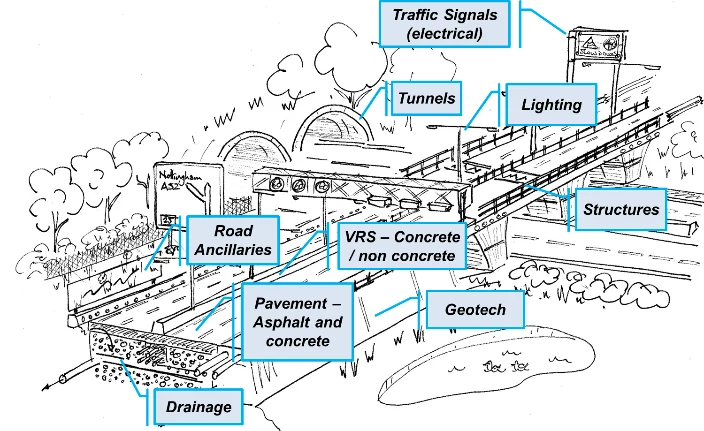
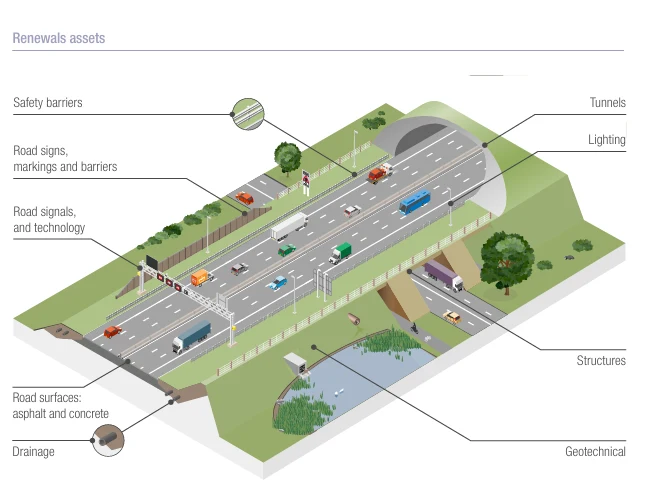
I’d been trying to get my head around nine asset classes at a client: road surface, drainage, vegetation, structures and the rest. I didn’t understand how they fitted together, and words weren’t helping. So, in my own notebook, I drew a roadside scene with every asset class in its place. Down by the road I put a balancing pond, and, as a bit of a giggle, a few ducks swimming in it.
It was meant for me, to see whether I understood.
Then I showed it to a few people. It got photographed. It got shared. For a doodle in a notebook, it went somewhat semi-viral. People who had never met me were passing around my picture, because it showed them something that pages of description hadn’t.
Five years later I saw it again. The organisation’s own graphics team had rebuilt it, properly drawn, polished and in the corporate style. The structure was exactly as I’d sketched it, with every asset class where I’d put it. And to my amusement, where once I had doodled ducks there are now, in print forever, swans.
The second doodle was much uglier. I was on a call with the person who’d created a diagram of how different parts of the transport system interacted. It was a box-and-arrow diagram, and I couldn’t follow it. So, as I listened, I started drawing it myself, in my own scrawl, to see whether I’d understood.
I doodle shapes and form, and filled in the gaps in colour as we spoke to bring it to life. As I drew it I understood it, and my colleague, too, could see straight away where I’d got it right and where I hadn’t. We corrected it together, there and then.
A few weeks later, a corporate viewpoint was published externally with that picture in it, professionally rebuilt. The original was still a mess, and it had still done the job.
I’ve thought about those two doodles often. Neither was meant for an audience. Both began because I didn’t understand something and needed to see it. That’s what made them useful to others: they were honest. They showed what was understood and what wasn’t, and people could see straight away where to help.
I think that’s the point many of us miss about visual thinking. We wait until the picture is good enough to show. But the value is often in the first rough version, the one that’s still ugly, because that’s the one people can respond to.
It’s why I enjoy all of it now. I get to be the thinker, working out what’s really going on. I get to be the doodler, getting it onto a page before it’s tidy. And I get to be the creative production arm, turning the doodle into something polished enough for a board paper, a report or a website.
Now I’m my own business, and I don’t wait. The tools available to the rest of us, not just to professional designers, have come on so far that I can take an idea from a scribble in a notebook to something finished and ready to publish. I can do the whole thing end to end, and I am: the thinking, the doodling and the final picture.
Nothing gets lost in the handover, because there isn’t one.
The person who sat in the room and worked out what was really going on is the same person who creates the version that goes in the report. The honesty of the rough sketch survives all the way to print.
It started with a couple of doodles, and I’ve never forgotten that. These days, my ugly ducklings transform into the swans too.
Over to you What’s the roughest sketch you’ve ever drawn that turned out to matter? And what stopped you showing it sooner?
Let’s talk
Have a rough idea to untangle?
A rough drawing, made with you in the room, is where understanding starts. A Rich Picture Sprint is built around it.